In early November 1939 we heard the
sound of aircraft to the east of Unst. They
eventually appeared flying low over the wick of Norwick. They were German
planes on their way to bomb ships that
were in Sullom Voe.
On 17th Jan 1940 the British Ship 'S.S. Polzella' (4751 tons) was sunk off Unst. There were no survivors. At the same time a
Norwegian ship the 'Enis' (1,800 tons), with a cargo of wood pulp destined for Dublin, was set on fire. Both lifeboats got away with the
crew, eight men in each boat. The Captain's boat with oars and
sail was picked up by a trawler and landed on
the British Mainland. The other boat, in
the Mate's charge, reached Unst. This boat had a motor. The
men were taken to Lerwick on the 'Earl of
Zetland'. The burning ship could be seen on the
horizon for several days.
In April 1940 on a beautiful sunny
morning a lifeboat came sailing into Norwick.
We were alerted by my brother, who was on his way
above our house at 'Valyie' to work on the Saxa Vord road. Annie and I went down to see what it was and the boat had
just reached the north side of the Taing.
It was the lifeboat from the 'S.S. Swainby'. All the
crew were safe but the ones that had been asleep
at the time of the attack had no time to get dressed so were only in vests and pants with bare feet. We took twelve of
them up to 'Valyie', where we found jumpers and socks for them to put on and gave them tea. We took two of them to the shop where
they could get clothes. The shop sent the
account to the Ship Wrecked Mariners
society. The Captain and Officers were taken to "Kirkatown"
and the 'Banks' and later in the afternoon a truck took them to Baltasound so they could be taken on to Lerwick.
Another ship, the 'S.S. Stancliffe', was sunk to the east
of Unst. A lifeboat eventually came into
Haroldswick with the crew in poor condition.
In April 1942 a Norwegian boat with refugees was near Unst
when their engine stopped. Hearing the
sound of planes overhead, one of the men took
his wife and two children in the small boat and sailed
towards the land that they could see. They
landed on Norwick Beach, just as it was getting dark. This family stayed with us at `Sunnieside' overnight.
The
Home Guard was formed and was led by Major W. Hunter. The men were issued with a great khaki coat and a rifle
and had a rota of service, in the evenings they
patrolled the coastline. Soon men were called up for war service and many joined
the RAF, Navy and Army. A lot of Unst men
were already in the Merchant Navy.
The new
'Earl of Zetland' began service in 1939 but was soon taken away for service elsewhere and the old 'Earl' was put back
on the route. Supplies
to the shops kept up very well and with local croft produce there were no
shortages. Croft work went on as usual with
work and forces men helping on their days off.
When the
RAF Station was to be built at Hamer Skaw there was no road to it, just a path from the 'Banks' to the top, so
work started on widening the path and it had to be
extended behind Lowrie Laurenson's
house and over part of the 'Bartleskirk' croft. This was in early 1940. In the
meantime hut sections were stacked on the ayre (beach) until the road was ready. When it was completed and
traffic was ready to use the hill men were assigned to control traffic using
red and green flags as the foot and top of "The Floggie" were out of
sight from each other and there were no passing places. As there was no source of water in Skaw it had to be taken up in tanks on the back of a truck. A pipe was laid from the
'Valyie` spring well along the road to the
lower end of the 'Floggie' road, where
the tanks were filled. To ensure that there was no loss of supply, Peter Hughson had the job of plastering the
outside walls of the well with concrete. It was and
still is a perfect spring. Later a dam
was built across the burn of Skaw, between Saxa Vord and the Wart to supply. Until this was ready the water was
continued to be transported up the 'Floggie'.
Watson's
Contractors from Edinburgh had two trucks and employed a lot of men from Unst
and outwith the island. The firm of J.L.
Eves from England erected the steel pylons. (Peter Moir was a teenage worker with them).
RAF
personnel arrived as soon as the camp was ready. There were no laundry facilities on the camp so their washing was
done at the local houses, so they soon got to know
the local people. There were also some
Army Soldiers from the Highland Light Infantry (HLI) and the Argyll and
Sutherland Highlanders. The Royal Artillery manned the anti-aircraft guns.
Saturday
night dances were held in the Haroldswick Hall and it was on its way to a dance that a lorry with workmen aboard slipped over the edge of the road, just at the back of
Lowrie Laurenson's house. One man from Yell
broke his leg; there was no dance that
night.
Waves
of Lancaster Bombers came over one evening on their way to bomb the German raider ship in Norway. There
was a Picture House on the Camp and local folk could go there too. There was also Entertainment Shows and Dances
in the NAAFI that the locals were welcomed
at as well. They were all very good. At
Christmas in 1944 they had a party for the local children in the NAAFI. Knitting
received a welcome boost when both workmen and service men saw the warm jumpers
and ordered garments for themselves and
their families.
There
were also Navy personnel stationed at Haroldswick at Hamarsgarth, who worked on the radar on Saxa Vord.
XXXXXXXXXXXXXXXXXXXXXXXXXXXXXXXXXXXXX
Peter Moir
(As recorded by his late son Norrie Moir)
The Accident
My father was Peter Moir, who hailed from Kinmundie in Aberdeenshire and had been introduced to Mum in a rather unusual way. He had worked for the Watson Company that built the wooden and steel towers, carrying the aerials, for the early “Chain Home” radar system. The same ones that were to prove so vital, to our defence in WW2, by pinpointing German air attacks as they came across the English Channel. He travelled all over the U.K. doing this work, and built the masts at the RAF station at Skaw in Unst, whilst there he worked with a local chap, Duncan Mouat from the Schoolhouse in Norwick.
Whilst working there he and a friend decided to go to the weekly dance, probably in the Haroldswick or Baltasound hall, one particular evening. They decided to get ready and catch "the transport," a lorry that left at a predetermined time, from certain pick-up points around the camp. Theirs being the last before the camp gates and the outside world. They miss-timed it and arrived, just in time to see the lorry pulling away. They gave chase, shouting and making as much noise as possible, to no avail as the laden lorry left without them. They chased it as far as the camp gates, soundly cursed the driver for being oblivious to their presence, and watched forlornly as the canvass covered back of the lorry receded in the distance. It was quite full too, some of those on board waved mockingly, as they trundled off up the road.
The
Flagi ©Shetsand Museum
Item Details: Photo Number; P04158, Photographer:
Peterson, J
This
is the local pronunciation, if you look up in The Shetland Museum Photographic
Archive, they spell the word Flagi.
They retreated to the NAAFI, to console
themselves with a pint, and bemoan their fate.
It was about a half an hour later, when a general commotion ran through
the camp, word had been received that the lorry had had an accident. Going down “The Floggey,”
the steep road that connected Skaw to Norwick,
the lorry had gone off the road and rolled down the steep slope at the back of
the house called “The Banks”. Many were
badly injured although I don’t think anyone died. It later transpired that the lorry’s brakes were
faulty, the driver had been in the habit of “changing down” as he started the
descent in order to slow the vehicle. This
time he had failed, to engage a lower gear, they had accelerated down the road
to their fate. Two quick thinking men,
in the back, had heard the crash of gears and realised what was about to
happen. Almost instinctively they had
grabbed a young lad, a teenager who happened to be on board, and thrown him out
of the back of the lorry and yelled at him to go and get help.
He had run, the mile or so, back
to the camp and raised the alarm at the guardroom. As there were probably few, if any,
telephones in the local houses it was probably the fastest way to get medical
help. Amongst those on board was an old
family friend, Henry Hunter, he suffered a broken collarbone and other
injuries. The miracle was that anyone
survived at all! It should be remembered that back then, the road did not run
the course it did in the 50's 60's and 70's, with the long curved bend at the
bottom. It came down between the two houses that sit nearest the sea, known as
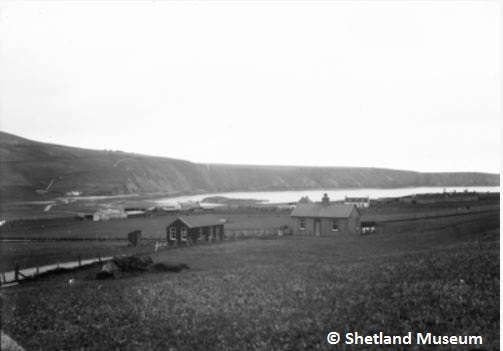
"The Banks" and the house of Laurence (Lowrie) Laurenson. The old
track of it is still visible, and some older photos of Norwick, show this road
as it was originally laid, as can be seen
in the photograph below.
Norwick and the old, old road, to Skaw,
©Shetland Museum
Item Details - Photo Number R00287.Photographer, Ratter, J D
I once saw a pay packet he had
kept from 1939; it came to £39-17/-7½d (£39 and 88.125p). This was a considerable sum, in those days,
when the average weekly wage was about £2-10/- (£2.50). The reason was that when they reached a
height of 50 feet the “danger money” they were paid doubled and did so again
every 50 feet thereafter. Some of those
masts were 350 ft high! I once asked him
if he ever worried about working at such heights, he said “no not really, once
past six feet you’ll break your neck anyway, six or sixty the outcome is
usually the same!” He gave it all up,
when conscripted in 1939, to join His Majesty’s Royal Air Force at the princely
sum of 6d. (2½p) a day!
(This photo, sent to me by Norrie, shows the lower part of
one of the steel Transmitter Towers at RAF Skaw. I believe that the small posts near the foot of the Tower had
been used to carry the feeder lines which
took the signal from the Transmitter Block to the base of the structure)
The first person he met, when he
walked through the gates of his reporting station, was Duncan Mouat. They were
to serve together all through the war, doing their “square-bashing at Blackpool, their physical training instructor was Freddie
Mills the famous boxer. Next they were
on a troopship to India, via
Cape-town where they visited Table Mountain, and thence on to Bombay.
From Bombay they crossed the Indian
continent by train, taking eight days, and then they caught another ship for Ceylon. There they were to spend four years; serving
on the island now called Sri
Lanka.
Whilst there my father asked Duncan for Mums address,
back in Unst, although he had seen her during his time there he had not
actually met her. Duncan gladly obliged and he wrote asking her
to be a pen pal, she replied and they corresponded all through the remainder of
the war. After the end of the war and
repatriation, he travelled to Unst to meet her.
They must have hit it off as they were married in 12th 13th
or 19th of March 1947.
In 1964, Shetland got TV, a Transmitter/Relay Station being
set up on the Ward of Bressay, I can remember my father remarking to me at the
time "Shetland could have had TV years ago!" When I asked how this
could have been, he told me the following story.
At the end of the war, or shortly thereafter, a signal was
sent, presumably from HQ in London,
reportedly saying "Blow up the masts in Uist!" For whatever reason,
misreading, a typo, and or mis-routing, it was read as "Blow up the masts
in Unst!" This was duly done, the perception was that had they stayed up,
they could have been used to convey TV to the islands.
©Norman. W. Moir.
Somerset, September 2012. Any writings
by me, are copyright, to me and to my immediate family, and may not be used in
any context, without the author's prior permission
Museum photographs are
copyright of Shetland Museum Photo Archive
XXXXXXXXXXXXXXXXXXXXXXXXXXXXXXXXXX
Pauline Palmer
(As recounted by the
Late Lexie McMeechan)
Miss Jemima Sutherland, who was the district nurse in
Unst during the war years (and for sometime after, told the
story of a baby boy born at the Skaw camp on the 22nd
June 1941 to the wife of the then Clerk of works. The young woman refused to
leave her husband even for the birth, against all advice. When Dr Saxby and Nurse
Sutherland were called there, on a lovely midsummer day, they were refused
entrance to the camp as there was an air raid warning on.
When they finally got permission to proceed the young mother
to be and an elderly helper were alone, as her husband had gone to his
emergency post. The baby was born at 0345 the next morning; both
mother and baby were safe and well. His father was still on duty when
the doctor and nurse left but the next afternoon (Sunday), when they
went back the couple's minister, from Lerwick, was there for the
christening, and there was a little celebratory gathering, which the
doctor and nurse were to share in. After renewed warnings the mother
was at last persuaded
to take
the baby
home to "somewhere in England"
where it was hoped they would be safe. I always wondered what happened to them

The parent's names were Pauline and James Palmer, the
baby boy was named James Spellisey Palmer (pictured above with
his mother). The helper mentioned who attended the birth was Mrs Clark,
whose late husband had at one time been the principal light-keeper at
Muckle Flugga Lighthouse.

By coincidence in the summer of 1998 a lady wrote,
from England, to Bayes Photographic Shop in Lerwick asking if they
could supply her with photographs of Norwick, Unst. She
explained that she had been there during the war and while she
and her husband were there she had a baby. My daughter Rita
was friendly with Mrs Laurenson who worked in Bayes and she had heard
the story, from Rita, of the woman who had a baby at the camp
at RAF Skaw in the wartime and how I wished that I could find her. I got her
phone number and when we spoke I realised I really had
'found' her after all those years! She told me that her son, James
Palmer, had died of a heart condition aged about forty. She
remembered Nurse Sutherland and they made contact. She sent a photo of
herself on her 80th birthday and a photo of her and the baby. I have often
spoken to Mrs Palmer on the phone and she is a very bright and cheerful
person.
Acknowledgements:
Shetland
Museum
Unst
Heritage Centre
The late
Norrie Moir
CONTENTS LIST