Tuesday, 15 December 2009

Life on Camp - The Early Days

When looking at the early days of Saxa Vord one needs to see the camp in its historical context. When the first equipment arrived in Unst in 1954 the Second World War was only 9 years in the past. WWII food rationing only ceased in July 1954, when meat finally became freely available (if you could afford it). National Service was still in existence - the final intake was as late as 1960 with the last National Serviceman being demobbed in 1963.

To begin with tours were unaccompanied and the only individual to have a Quarter was the CO. Even he did not get an RAF Quarter - there were none. He occupied an AMWD (Air Ministry Works Department) Quarter which was lent to the RAF. Very few people had cars and, when the station opened in 1957,  severe petrol rationing brought on by the Suez crisis, was a recent memory.

All of the photographs in this section belong to David Goodall (Saxa 1959-61) and I am grateful for his permission to use them. They were all taken on camp during his tour. (Left click to enlarge)
 
CONTENTS LIST

Friday, 11 December 2009

The Most Intimidating Golf Course in the World? - Updated 3 Oct 12


Most Golf Courses have their hazards, usually bunkers or sand traps, as they are sometimes called – like the course at RAF Tengah seen in the picture below.(Left click on photos to enlarge).
When I arrived at Saxa in 1967 I was rather surprised to find that there was an active golfing community. The Public Services Institute, or PSI as it was more usually known, kept a range of sporting equipment for loan and items were available at the Guardroom. This equipment included a number of sets of golf clubs. PSI also had a minibus (supplied by the Nuffield Trust), which could be borrowed. In the late 60’s some keen servicemen had created their own golf course on Unst at a place called Lamba Ness (sometimes known as Inner Skaw).  Lamba Ness was the site of RAF Skaw, a WWII CH radar station. The RAF course had its share of bunkers but they looked slightly different
The hazards on the Saxa course were rather more intimidating, as can be seen in the next 2 photos:
This can be better envisaged from the next phot0, which was taken from one of the Tees:


The green and flag can be seen in this enlargement:

A number of the other Tees were situated at the edge of geos (ravines) and many a golf ball was lost forever. Anyone going on leave was likely to be asked to bring back more balls. The 9 hole course had to be maintained by servicemen in their off-duty time but most of us felt it was worth the effort to enjoy really exciting golf.

The golf course received a significant amount of attention in the press – especially after the decision to hold 24 hour golf matches at midsummer. Most people in UK don’t appreciate the Unst, at a latitude of about 61 degrees north, is only 300 miles south of the Arctic Circle. The Shetlanders call a period around the summer solstice (midsummer) the simmer dim. It is a short period when, if the weather is reasonable, you can stay up all night, read a newspaper at midnight or, in the case of golfers – play 24 hours non-stop.
I am uncertain how many years this event took place at Lamba Ness but I know that there were competitions at midsummer 1968, 1969 and 1970 - I actually took part in 1968. Copies of some of the coverage of these events is below:


The next sequence of photos shows the most northerly golf course in UK (ever!), being enjoyed – mainly by the people who maintained it.
The next 3 pictures show the location of the course from a wider perspective, the first from the eastern extremity of the course:
The final picture is a download from Google Earth and it shows the coastline in a bit more detail – much of the course was on the south side of the headland, within the red rectangle shown:

So – what happened to this course, the most interesting I’ve ever played? Very early in the 70’s, possibly as early as ’ 71 it closed down & has not been used since. My theory (backed only by rumour) is that the players wanted a better & better course. – not unnatural, wanting it to be as good as possible. Perhaps people lost sight of the fact that this was crofting land - i.e. sheep grazing. Attempts to cut fairways would have deprived the animals of their feed (and the crofters of income). At some stage the land users would have wanted their land back!

A new course was established fairly quickly between Burrafirth and the Loch of Cliff. The main hazard on the new course appears to have been golf balls "plugging" in the soft, flat ground. Knowing the area I am sure that it didn’t have anywhere near the excitement of the previous course. I have very little information on this later course and, unless I can be provided with enough interesting information about it, am unable to write about it.


CONTENTS LIST

Tuesday, 8 December 2009

Presentations to Civilians Part 1


My late father-in-law, Hughie McMeechan, kept a scrap book during the time he was employed at RAF Saxa Vord. In that period a number of presentations were made to civilians on the camp. The following photos and clippings are from his scrap book. I have photos of other presentations which I will publish in the future. (Left click on the picture to increase size)

A later section appears here:
 
CONTENTS LIST


Saturday, 5 December 2009

The Heroes of Saxa - 1968

There was a tradition of celebrating the longest day - midsummer - at Saxa Vord. In 1968 a crisis occurred when the North of Scotland Shipping Companies ship the Earl of Zetland failed to deliver an expected consignment of beer just before the Airmen's Midsummer Dance. This was in the days before the RoRo Ferries and a round trip to Lerwick usually took 3 days. The Camp was out of beer!

Four heroes came to the rescue. Taking a small boat they set off to Lerwick on their mercy mission. They travelled through the night and most of the next day, arriving back at Baltasound just before the start of the Dance with a valuable cargo. The four crew were:

Cpl Aves
Cpl Hawker
Cpl Palmer &
Cpl Pope

They were not mentioned in the New Years Honours List - no justice in the world!

CONTENTS LIST

Sunday, 29 November 2009

The Red Star Board

Throughout the cold war there were occasions when Soviet aircraft entered the United Kingdom Air Defence Region. These aircraft had a variety of missions - some were en route to Cuba or Angola, some were practicing with their own naval forces, some were gathering elint and others were practicing offensive missions against NATO forces (including radar sites). It was policy for NATO forces to prove that these aircraft movements could be intercepted should there be a need to do so.

The Norwegian Air Force would normally provide information on outbound aircraft coming round the North Cape of Norway and sometimes the Norwegian Air Force would intercept them. The USAF were based in Keflavik, Iceland. In the mid sixties they were operating EC121 AEW aicraft (based on the Super Constellation) and F102 Delta Dagger Fighters. I always thought it was rather brave for their fighter pilots to be operating single-engined fighters hundreds of miles out into the North Atlantic in all seasons. Eventually the F102's were replaced by F4 Phantoms.

Between Iceland and the UK was the High Powered Reporting Post, manned by Danish Personnel, on the Faeroes. Occasionally they would be given control of RAF or USAF aircraft.

The UK Forces included  early Lightnings, which couldn't go very far, later there were Lightnings with longer range - which was extended still further with Victor Tankers. 8 Sqn was reformed in 1972, this time equipped with the "new" Shackleton AEW Mk2's. Despite equipment serviceability problems and slow speed the Shackletons were a valuable gap filler. Later on F4 Phantoms, Tornadoes, E3 Sentries and later tankers - VC10, Tristar - were introduced. All of these assets were at some stage controlled by ground radars and, because of it's location, Saxa Vord was far more heavily involved than all the other UK sites.

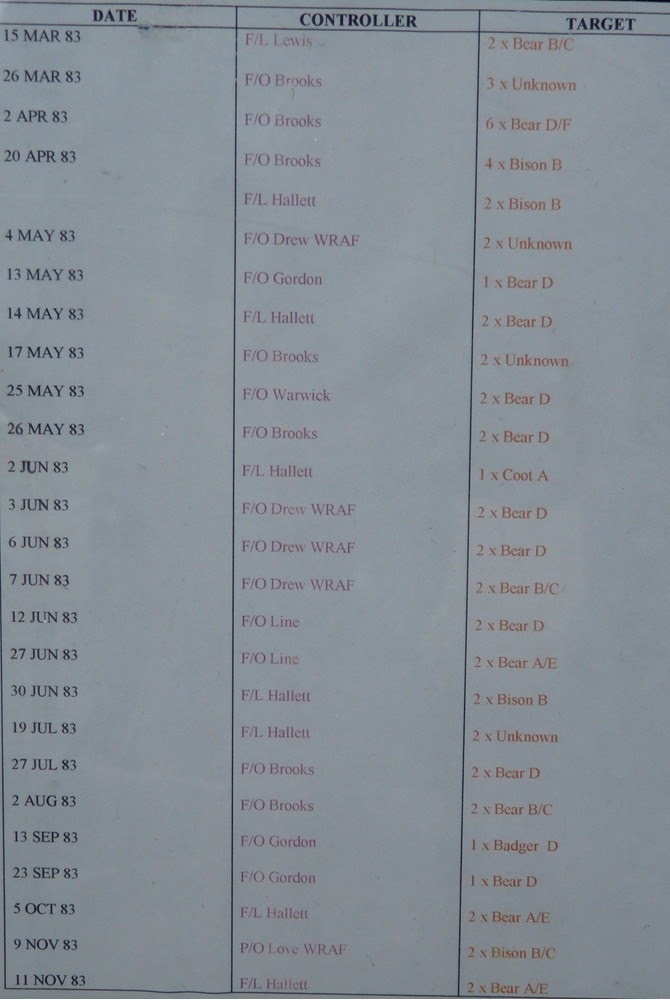
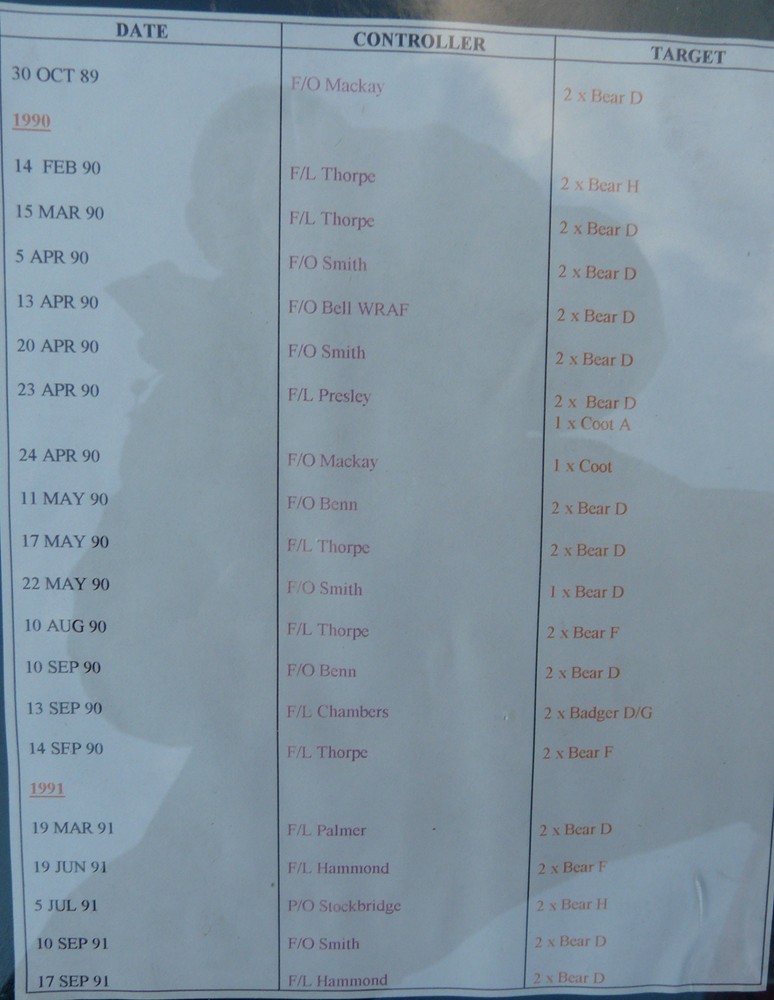
Very early on in these operations it was decided to recognise the first intercept of each Soviet intrusion by awarding the contoller involved a "Red Star Tie" and by recording his name on the "Red Star Board". The red star was chosen because of the insignia painted on the tail of Soviet aircraft. At the start I believe the Red Star Board looked like the board one would find in Station Headquarters on most RAF Stations listing present and past CO's. It would have been made of wood and details inscribed with gilt lettering. Over the years, as numbers of intercepts grew, this must have become impractical. The Board must have been updated and replaced on more than one occasion. The final board contains 19 A4 sheets of typed data and it is that data which is shown below. My apologies for the poor quality but the information had faded in places and it was difficult to get clear pictures through thick perspex.

(Left click on photos to enlarge, click again to enlarge further)


Red Star Tie
The Red Star Tie obviously featured a red star. It was on black background and fronted by a portcullis.
The portcullis was a feature of the crest of Fighter Command which commanded all the UK Air Defence Radar Stations until 1968, at which point command transferred to Strike Command. A portcullis was symbolic as a medieval defensive feature.

CONTENTS LIST