In the next year or so I hope to produce articles about each
of the RAF radar sites constructed in Shetland during WWII. This short piece is
meant to show where these units were located and to give a brief explanation as to why they were built. At the start of WWII there were no operational air defence radars
in Shetland. The famous Chain Home system, which performed an invaluable
service in the Battle of Britain, did not reach these northern latitudes until
later. Chain Home(CH) eventually covered
the whole of the UK coastline but at the start of the war the most northerly
site was at Netherbutton in Orkney, where the equipment was designed to look to
the south-east. Work on the Netherbutton installation began in May 1939 and the
initial Advance CH station was handed over to the RAF the following month. The
main purpose of this unit was to give early warning of possible air raids,
originating in Germany or the Low Countries, against the Home Fleet in Scapa
Flow; hence the orientation of the radar cover.
The Royal Navy had organised its
own radar stations for the Northern
Isles. Six Coastal Defence U boat sites (CDU's) were built from the northern
tip of mainland Scotland right up to the north end of the Shetland Isles -
these were known as Admiralty Experimental Stations (AES) 1 to 6. Four of these
stations were built in Shetland, the first (AES1) at Sumburgh Head, opened in Dec
1939. AES 2 & 3, both on Fair Isle, followed a few months later and AES 4
on Saxa Vord opened in Sep 1940. The main function of all of these RN stations was the detection and
tracking of submarine and surface contacts. In the early part of the war the
data they obtained was passed though landlines to the Naval HQ. These stations
were equipped with similar equipment to RAF Chain Home LOW (CHL) radar units
and, although quite capable of detecting aircraft in their vicinity, this was
not their primary role and, initially at least, the communications system was inadequate for passing information on airborne intruders rapidly to airfields or fighter aircraft. Furthermore;
in the early days, Shetland lacked adequate fighter cover. For the first 9
months of the war the only aircraft fulfilling this role were 3 Gloster
Gladiator biplanes (top speed around 250mph). Most of the German intruders in
the area were Heinkel 111's with a top speed of about 270mph and Ju 88's,
capable of nearly 320mph.
The German invasion of Denmark and Norway in April
1940 brought about major changes in RAF planning and better radar cover in the
Shetland area was provided with some urgency, particularly to the east and
north. Almost immediately a transportable radar unit was formed and deployed to
Shetland, see:
http://ahistoryofrafsaxavord.blogspot.co.uk/2013/01/the-first-radar-on-unst.htmlMany sites throughout the UK had been surveyed to assess their suitability as locations for radar installations, including some on Shetland. It was decided to go ahead and construct Chain Home Stations at two sites in Shetland, at Lambaness (Inner Skaw) on Unst and at Noss Hill, just over 3 miles north west of Sumburgh Airfield.
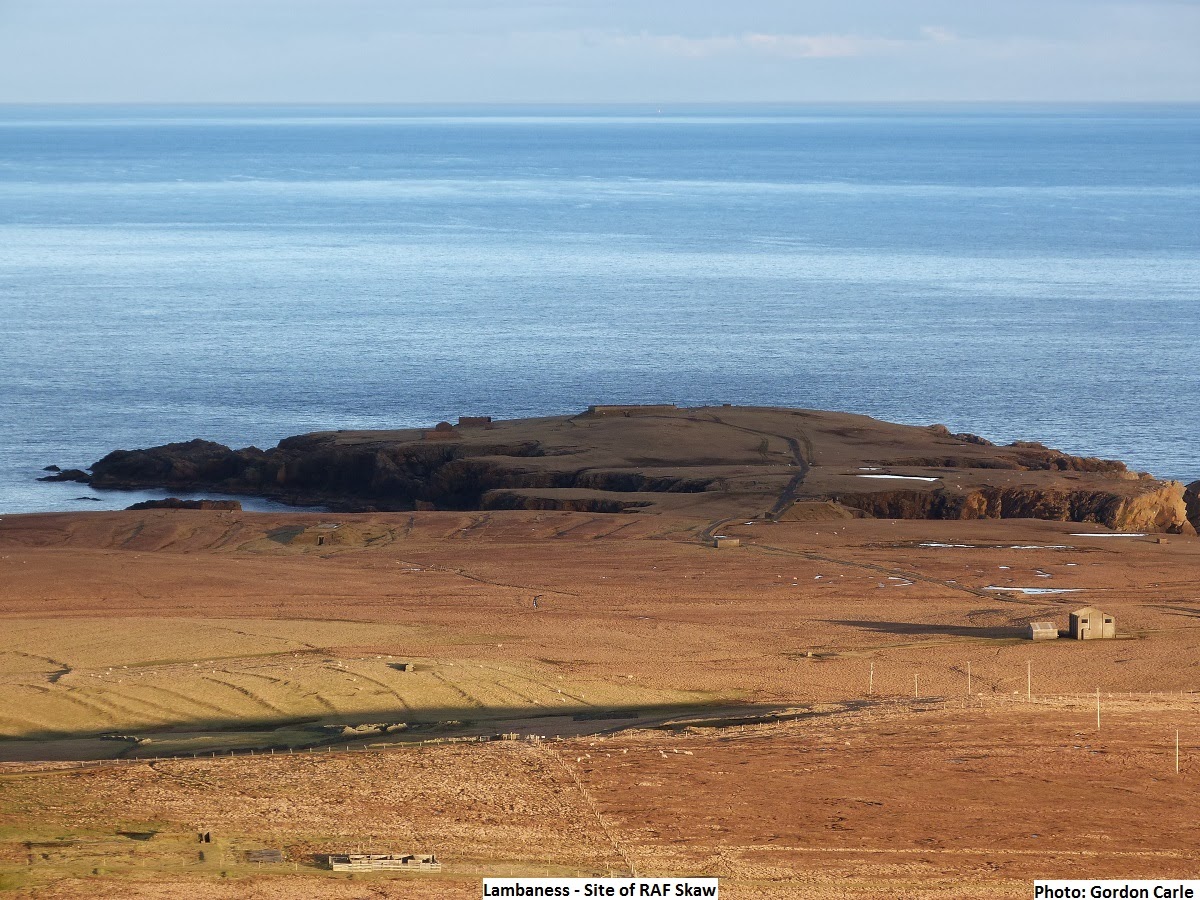

In addition; in July 1940 a few Hurricane Mk1's were
deployed to the grass field at Sumburgh, providing a much more potent fighter force.
The building of the Chain Home System was probably one of the biggest
construction programmes ever undertaken in the UK but the remote Shetland
Islands provided a particularly difficult challenge. All of the timber, steel,
cement and electronic components had to be shipped up from mainland Scotland in
wartime conditions. Not only were the materials required but skilled workmen
employed by specialist contractors had to brought into the islands and
accommodated. Firms like Watsons, JL Eve , & Riley and Neat, were heavily involved. Vast
quantities of bricks from Lothian brickyards were shipped up from Leith.
Considering the difficulties it is surprising to me that the Advance CH
stations were operational as early as they were. RAF Noss Hill was on the air
in December 1940, followed by RAF Skaw in January 1941 - the transport of
materials to a site on Unst being a little more complicated. To digress
slightly, as mentioned above, Noss Hill and Skaw both opened as Advance CH
stations. These were fully operational sites with transmitter, receiver and
generator huts protected by blast walls. The aerials were on 90ft wooden masts.
Work continued at both sites to bring them up to full CH status. The ACH layout at Noss Hill; for example, can
be seen in this recent Flash Earth image:

The final CH sites would have hardened bunkers to protect
their receivers, transmitters and standby generators. New 240ft wooden receiver
towers and 350ft steel transmitter towers would also be erected.
The question of achieving
better coverage against low-flying aircraft was also addressed. In June 1941 it was
decided to build two RAF Chain Home Low stations, one to the west of Walls on
the Shetland mainland (RAF Watsness) and the other on the island Whalsay (RAF
Clett). There were delays in these sites becoming operational, bad weather and
late delivery of components affected both units, whilst Clett had further
complications caused by an extra sea
crossing and by a pier at Symbister which hadn't been designed for heavy
equipment! RAF Watsness became operational in February 1942 and RAF Clett in
the following month.
The site of the RN
radar at AES 1 Sumburgh Head was excellent for giving coverage south towards
Scapa Flow and for monitoring the gap between the Shetland Mainland and Fair
Isle. However; it was a poor site for much else, with the foghorn and
lighthouse tower obscuring large segments of the sky around the site. The
modern picture below shows the transmitter building (in the centre with a
peaked roof). The original roof would probably have been flat and, at the beginning,
would have had a hand rotated CHL aerial on a wooden gantry above it - with a similar aerial above the roof of the receiver hut.

The
receiver aerial, to the west of the transmitter was also obstructed by the
buildings causing more "blind sectors". It was decided to build a new
unit on a site a little further north at Compass Head. Developments in radar, such
as powered turning for the aerials rather than hand-cranking by manual operators, meant that it was simpler
to provide 360 degree cover around each CHL/CDU site. Better equipment was
installed at Compass Head and the radar at Sumburgh Head became a back-up
facility. In 1943 the site was transferred to RAF control as RAF Grutness. The
next picture shows the location of the radars with the CHL/CDU units marked in white:

With continued advances in radar technology all of the 8
static sites in Shetland were modernised as new equipment became available. Improvements
in communications also played an important part in achieving success. For
example, AES4 on Saxa Vord was largely dependent on a single GPO line
connecting though the Haroldswick Post Office when it first became operational.
Personnel became frustrated when they could see hostile aircraft and friendly
fighters on their radar but were unable pass vectors to the fighters, resulting
in a number of missed interceptions. Speedier W/T, R/T and landline links enabled
fighters to be directed against enemy intruders more efficiently and led to the
destruction of, or damage to, numerous German raiders. Over the coming months I
hope to write more about each of the RAF units in detail. After that I may carry
on to write to write about AES 1, 2 & 3 - a piece on AES 4 has already been
issued here:
Should anyone have any data or pictures of any of the
Shetland radar sites I would be pleased to hear from them:
gordon.carleATgmail.com (replace the AT with the usual symbol).
Some further articles (added Jul 18)
http://ahistoryofrafsaxavord.
http://ahistoryofrafsaxavord.blogspot.co.uk/2018/04/a-history-of-raf-skaw-ames-no56-part-1.html
RAF Skaw (AMES 56) - Part 2 - Advance CH - From Jan 41 to May 42 (16 May 2018)
http://ahistoryofrafsaxavord.blogspot.co.uk/2018/05/a-history-of-raf-skaw-ames-56-part-2.html
RAF Skaw (AMES 56) - Part 3 - CH Ops
http://ahistoryofrafsaxavord.blogspot.com/2018/05/a-history-of-raf-skaw-ames-56-part-3-ch.html
RAF Skaw (AMES 56) - Part 4 - Transmitters & Receivers
http://ahistoryofrafsaxavord.blogspot.com/2018/06/a-history-of-raf-skaw-ames-no-56-part-4.html
Some further articles (added Jul 18)
RAF Clett 1942 - 1945, AMES 96a
http://ahistoryofrafsaxavord.
RAF Watsness 1942 - 1945, AMES 55ahttp://ahistoryofrafsaxavord.
http://ahistoryofrafsaxavord.
RAF Noss Hill
- Air Ministry Experimental Station (AMES) No 54 http://ahistoryofrafsaxavord.blogspot.com/2016/03/raf-noss-hill-air-ministry-experimental.html
RAF Skaw (AMES 56) - Part 1 - Inception to Jan '41 (15/o4/18)http://ahistoryofrafsaxavord.blogspot.co.uk/2018/04/a-history-of-raf-skaw-ames-no56-part-1.html
RAF Skaw (AMES 56) - Part 2 - Advance CH - From Jan 41 to May 42 (16 May 2018)
http://ahistoryofrafsaxavord.blogspot.co.uk/2018/05/a-history-of-raf-skaw-ames-56-part-2.html
RAF Skaw (AMES 56) - Part 3 - CH Ops
http://ahistoryofrafsaxavord.blogspot.com/2018/05/a-history-of-raf-skaw-ames-56-part-3-ch.html
RAF Skaw (AMES 56) - Part 4 - Transmitters & Receivers
http://ahistoryofrafsaxavord.blogspot.com/2018/06/a-history-of-raf-skaw-ames-no-56-part-4.html
CONTENTS LIST


